Friday, August 31, 2018

Portrait of Maria Kirch


Maria Kirch (1670-1720)  was a German astronomer, born Maria Margaretha Winckelmann in Saxony, Germany.  Her father, a Lutheran minister, and her uncle, who raised her after her parents died when she was 13 years old, insisted on giving her an education equal to that received by boys.  Maria was bright and took an early interest in astronomy, a science developed by Galileo at the beginning of the 17th Century, but still in its infancy.  Maria became the assistant to an amateur astronomer and farmer who lived near Leipzig, Germany, and through him met the renown astronomer and mathematician Gottfried Kirch.

Although he was thirty years her senior, Maria Winckelmann fell in love with Kirch and married him in 1690.  Kirch gave her further tutoring in astronomy until she became his assistant, then his partner.  In 1700 they moved to Berlin where Gottfried became the royal astronomer to Frederick I, the first King of Prussia (and grandfather of Frederick the Great).  Frederick promised to build an observatory for him, although it was not completed until after Kirch’s death.  The unpaid position was part of the newly founded Royal Prussian Academy of Sciences, which held a monopoly on the sale of calendars.  Together the Kirchs produced data for these calendars, as well as for nautical almanacs and astrological charts.  From the calendar sales they received a small income.  Calendars required a great many astronomical observations since they provided information on the position of the planets, times of sunset and sunset, the phases of the moon, moonrise and moonset, solar and lunar eclipses, etc.  Observations were done with small telescopes and quadrants, which measured altitude. 

Every night, from their home, Gottfied and Maria would make observations of the heavens.  At 2 AM on April 21, 1702 Maria was still watching the skies after her husband had gone to bed.  It was then she saw what seemed to be a fuzzy star just above the horizon, something that had not been there the night before.  She awakened her husband, who confirmed that she had made the exciting discovery of a new comet.  That night two Italian astronomers made the same observation of what would be known as the Comet of 1702 (C/1702 H1).  For some reason, Gottfried Kirch initially claimed the discovery for himself, though later would admit the truth, that his wife had seen it first.

 
Maria Kirch, independent of her husband, published several papers based on her astronomical observations.  These dealt with the Aurora Borealis, the conjunction of the sun with Saturn and Venus in 1709, and the conjunction of Saturn and Jupiter in 1712.  She made quite a name for herself  and was hailed as an example of how the female sex could excel even in scientific fields.  Nevertheless, when her husband died in 1710, her attempt to assume his position ran into difficulties.  The Royal Prussian Academy of Sciences eventually rejected her, despite her qualifications and the fact that she had been championed by its president, Gottfried von Leibniz, a philosopher and mathematician, famous for inventing calculus (along with Newton).  It was obvious Maria had been rejected because of her gender, but also because she held no university degree, (which would have been impossible to obtain since no university at that time admitted women).  While progressive men like Leibniz took satisfaction from  the achievements of women, there were still many who wished to keep women in their place.  The job was given instead to a man of questionable competence.

Despite this setback, Maria Kirch continued to publish works on astronomy.   In 1712 a friend and patron of her husband and an amateur astronomer, Baron Frederick von Krosigk, placed her in charge of an observatory he had built with the title of master astronomer. Unfortunately, he died two years later and Maria had to seek employment elsewhere.  Briefly, she assisted a mathematics professor in Danzig, but turned down an offer to go to the court of Peter the Great of Russia.  She continued to reside mostly in Berlin, where she fulfilled commissions from neighboring states to formulate calendars.  She also, quite reluctantly, drew up horoscopes for her friends and clients.  Maria, like her husband, had rejected astrology, then still closely linked with astronomy, and, like most astronomers, advocated the not-yet-universally-accepted theory of Copernicus that the earth revolved around the sun and not vice versa.  A religious person, Maria argued that the Copernican theory was consistent with Christian teachings.  

Gottfied and Maria Kirch had trained their son and three daughters in astronomy  and all of them worked in the field.  In 1716 son Christfried was able to secure his father’s old position when the man who succeeded Kirch died.  He would work at the academy’s observatory, which had been completed in 1711.  He was able to bring along his mother and siblings to assist him.  Maria, however, ran afoul of the academy members who demanded she make herself scarce when visitors came to the observatory.  The presence of a woman doing scientific work and knowing so much about it was apparently an embarrassment to them.  Maria was therefore forced to leave and fend for herself.  She died of a fever in Berlin on December 29, 1720.  Her children continued her work in astronomy.

Sunday, February 4, 2018

Exhibition at Intuit

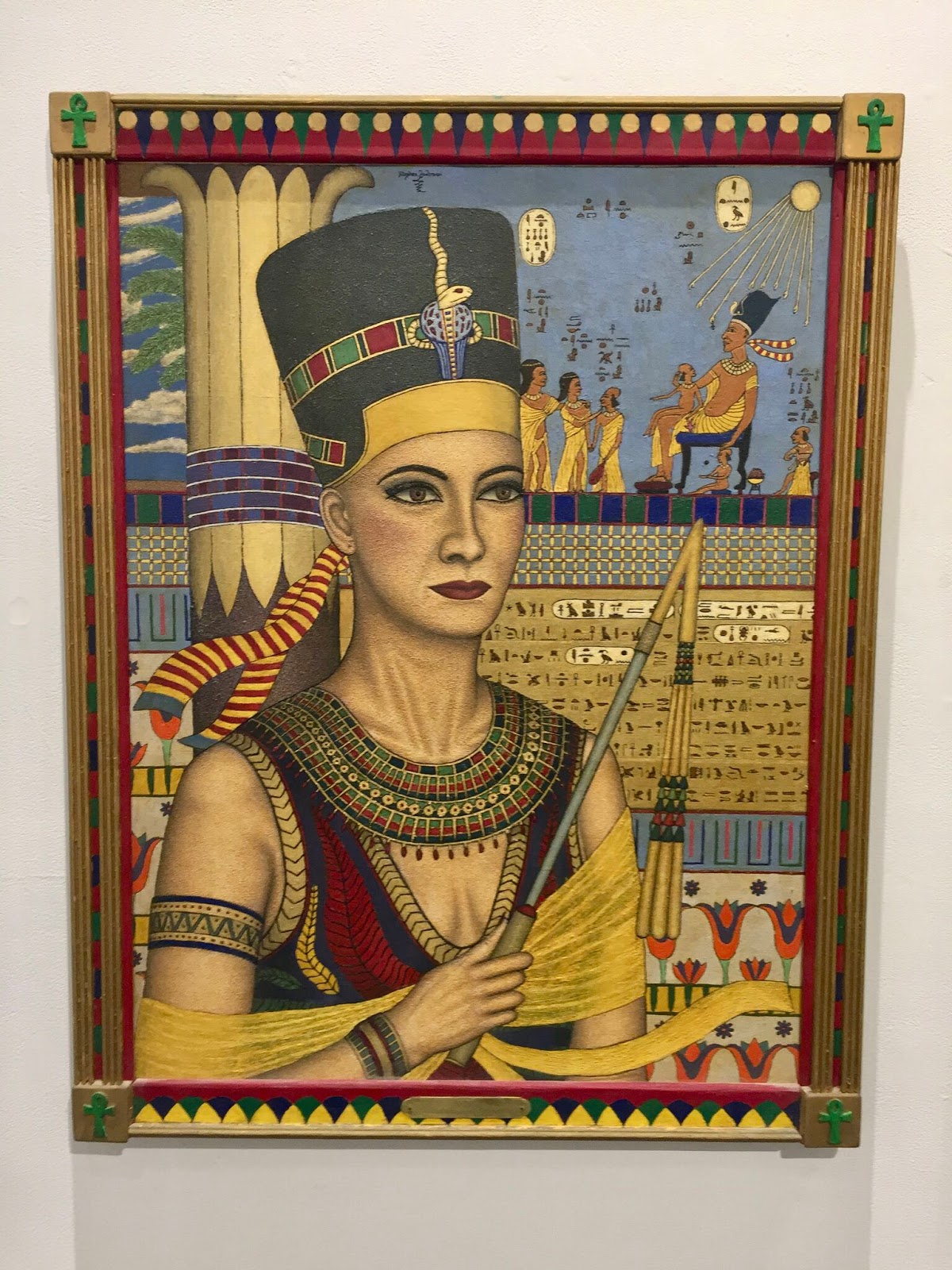
On January 26, 2018 was the opening reception for Stephen Warde Anderson: Attention to Detail, an exhibition at Intuit: The Center for Intuitive and Outsider Art, 756 N.Milwaukee Ave.,Chicago IL.   The show features more than three dozen samples of my early, tempera/gouache paintings (1980s and 90s) borrowed from Chicago area collections.  It was curated by Mike Noland and Keith Sadler.  Mike, a superb artist from Woodstock IL, is a long-time friend, as is Keith, who possesses the largest collection of my work.  They did a great job: I was very pleased with the installation and how my work was presented.  (Many of the pieces I have not seen for 25 years or more)!  During the reception I was able give a talk about my work to a surprisingly large audience.   The show will be up until May 13th.  Here are some installation shots and images of a few of the paintings in the show.


Self-Portrait  1995 tempera 24" x 29"


Karen Carpenter with Drums  1992 tempera  36"  x 28"


Nefertiti  1986  tempera  31" x 23"


Jane Austen  1987  tempera 27" x 21

My current work for sale may be a seen at www.swa-art.com


Thursday, October 13, 2016

Alien Zoo


Alien Zoo 20 x 24 Inches, Acrylic on Illustration Board on Panel, 2016

I have a considerable body of work featuring the familiar gray aliens, but in this painting I have created a new race of aliens.  These are the inhabitants of the earth-like planet of Azura.  The Azurites are fairly human-like, but with somewhat different noses, no eyebrows, hair that grows out to the side of their head, black eyes, and, most distinctively, blue complexions.  The Azurites are devoted to studying the life forms throughout the galaxy and have zoos to house "alien" specimens.  Depicted is the exhibit of earth creatures, a family of homo sapiens.  The family, collected from earth, were not too unhappy to leave their planet, are quite content in their compound, and do not miss the outside world provided that they have access to all the devices, TVs, cellphones, tablets they are accustomed to and are given plenty of junk food to eat.  The Azurites look in upon them with curiosity, disapproval, and amusement. 

More of my work can be seen on my website www.SWA-art.com

Wednesday, November 18, 2015

Spacescapes

At a very early age I became interested in space, space travel, flying saucers, and so forth, initially inspired, I imagine, by my childhood affection for a horrendously bad TV show "Flash Gordon," which looked like it was made in someone's basement, a basement in Germany actually, using actors dragged in off the street.  (I was too young for "Rocky Jones, Space Ranger," a current favorite of mine that was really good early TV.)  I  have found more recent inspiration in other space operas that I like: those American rocket-to-Mars flicks from the '50s, Italian space movies from the mid '60's, Space:1999, the first season, Buck Rogers, also the first season, and the obscure but delightful Space Maidens. -- sorry not a Trekkie or a Star Wars fan.) 

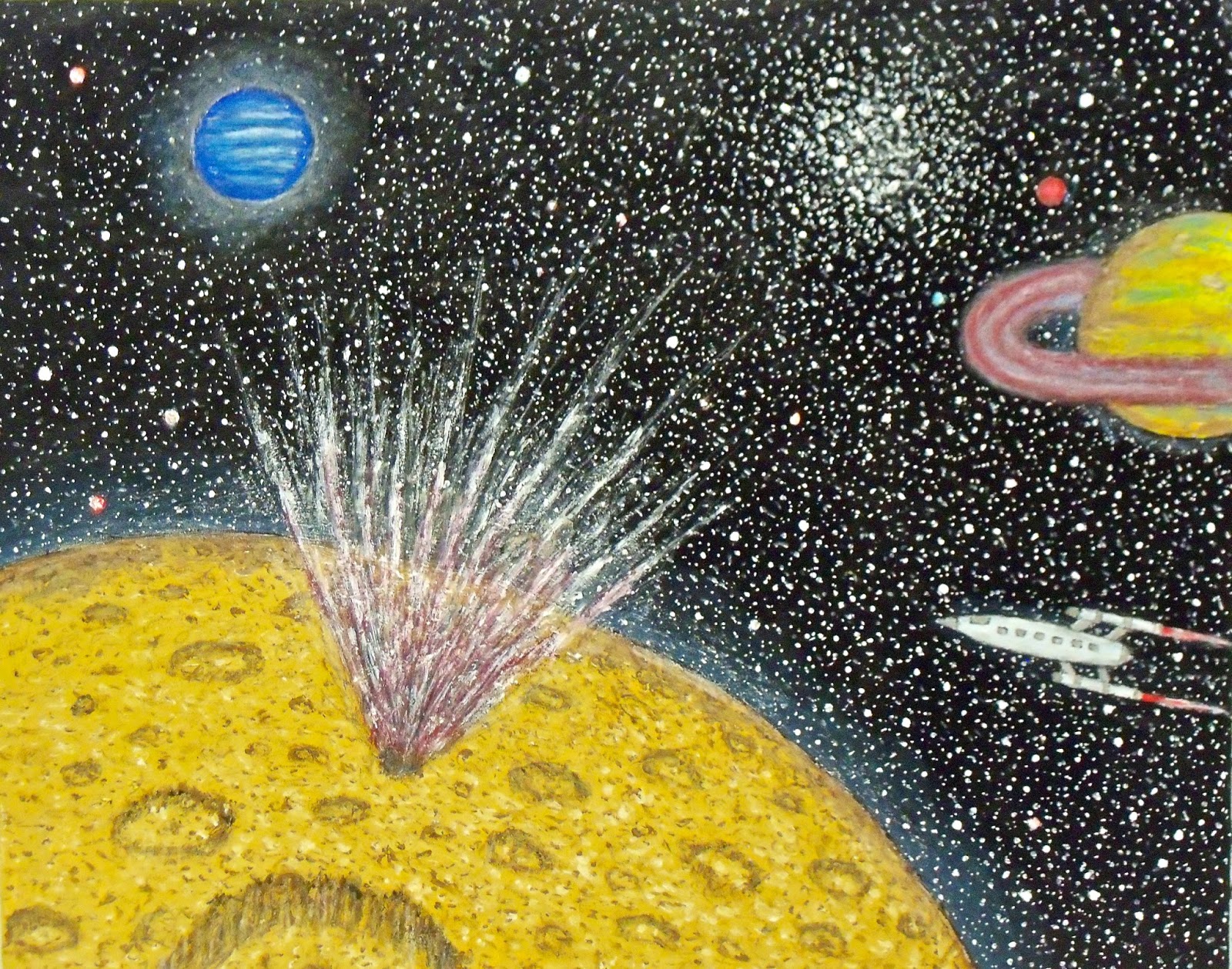
As an artist I have done from time to time some space-themed paintings.  Lately I have embarked on a series of spacescapes, scenes of outer space with planets and moons, comets and spaceships and also landscapes of alien planets.  They are totally out of the imagination, which I love, and can be executed without a great expenditure of time.  Here are the ones I've done so far.


Crash on a Volcanic Planet, Meteor Strike, Planet of the Mushrooms, Rising of a Moon 16 x 20 inches, acrylic on illustration board on panel, 2015

Saucer Convoy, Zapping an Asteroid  11 x 14 inches, acrylic on illustration board on panel, 2015

For more of my work see my website at www.swa-art.com

And you may follow or friend me on Facebook

Monday, August 31, 2015

Paintings of Jesus


Raising of Lazarus 18 x 24 inches, Acrylic on Illustration Board on Panel, 2015

Jesus Walks on Water 18 x 24 inches, Acrylic on Illustration Board on Panel, 2015

While I have been translating the Old Testament (and have published volume one of The Anderson Revisionist Bible which includes Genesis and Exodus), I have also been working on the New Testament as well (and have published The Gospel of John).   Of course this has inspired me to do some Jesus pictures as well as Moses pictures.  The first two of these are shown above.

In Raising of Lazarus we have Jesus approaching the tomb of Lazarus and calling him from the grave, after the stone has been rolled away from the cave/tomb.  Lazarus staggers to his feet, still wrapped up in linen grave clothes.  At Jesus' side are Lazarus' sisters Mary and Martha.  The many mourners who are witnessing the event are in the the background, but not painted for sake of keeping the composition simple and preserving the dramatic impact.  Most paintings depicting of this incident do not conform at all to the sole and somewhat spare account of this miraculous event that is related in the Gospel of John.  I have tried to be as faithful as I could to John.  We know nothing of Jesus' appearance save that he looked and dressed as an ordinary person who did not stand out in a crowd.  As a first century Galilean and Judaic rabbi, he would have had a simple beard and hair that might be a little longish by modern standards, but most definitely not shoulder lengthened.  It's a fair bet he had brown eyes and black or dark brown hair.

In Jesus Walks on Water some of the apostles are crossing the Sea of Galilee in a boat at night, during a storm when they see Jesus walking on the water.  I assume Jesus would have taken off his sandals when he made his watery trek.  A stiff breeze is blowing his robe.  Simon Peter is the middle figure in the boat.  In the Gospels of Mark and John the apostles see Jesus walking on water and bring him on board the boat.  Jesus calms their fears and the boat safely reaches the shore.  In Matthew, written after Mark, Peter walks on water as well, until he loses faith, sinks, and must be saved by Jesus.  (This seems like an embellishment of the story intended to give it a moral.)  The boat painted is intended to be similar to a 1st-century vessel recently unearthed in the Sea of Galilee and named the "Jesus Boat." I tried to convey the appearance of rain, but not the sense of darkness, which would obscure the figures too much and make the scene too hard to read. 

More of work can be seen on my website www.artmajeur.com/stephander

Feel free to friend me on Facebook

Friday, April 3, 2015

Lady Jane Grey

Lady Jane Grey 24 x 20 inches, Acrylic, 2015

My latest historical portrait is of the ill-fated but fascinating Lady Jane Grey, who, during nine days in July of 1553, was Queen of England.  She was the granddaughter of Henry VIII's sister and when Henry VIII's fifteen-year-old son Edward was dying, he appointed her his successor (passing over his half-sisters Mary and Elizabeth and Jane's mother).  This was probably at the connivance of John Dudley, the Earl of Warwick, who ruled England during the last part of young Edward's reign and had married his son Guildford Dudley to Lady Jane Grey.  Even at age sixteen, Jane, very strictly brought up,  had gained a reputation as a scholar, knowing not only Latin and Greek, but Italian and Hebrew.  While she was undoubtedly the tool of others, the fact that she refused to allow her husband to call himself King suggests that she had a mind of her own.  Her reign, though promising, was very brief.  The ruling council that had endorsed her quickly changed its mind and backed Mary who was proclaimed queen and consolidated her power within days.  Lady Jane Grey and those who had supported her were imprisoned and later executed.  The Catholic Mary, who is infamous as "Bloody Mary," was, in fact, willing to allow her cousin Jane to live, but felt compelled to seek her death when a rebellion was hatched in her name.  Poor Jane was barely seventeen when she faced the headsman's axe, which she did with considerable aplomb.  Jane's brother-in-law Robert Dudley would achieve prominence as a favorite of Queen Elizabeth and her younger sister Catherine would be regarded for a time as Elizabeth's heir.   

No definite portrait of her exists, although there is a painting or two and a miniature that some experts believe may be of her.  Even physical descriptions of her are of uncertain authenticity.  I have referenced one of the probable portraits, but have used my imagine in depicting her.   Her right hand is upon a volume of Plato and her left tentatively reaching for the royal orb.  Her clothes are shown as too large and ill-fitting, as was the role history chose for her.  In the background is the Tower of London.

Lady Jane Grey was the grand niece of my 11th great-grandmother Lady Cecil Grey, who also married a Dudley, the 3rd Baron, (whose debts allowed his cousin, the Earl of Warwick, to appropriate Dudley Castle and render the family homeless). In other words, she was a second cousin of Captain Roger Dudley, who was the father of my 8th great-grandfather, Thomas Dudley, Governor of the Massachusetts Bay Colony.

You can see more of my work on my Facebook page and on my website

Thursday, January 29, 2015

Joan of Arc

As a fan of Joan of Arc and Joan of Arc movies, I have painted her many times, although the first was not done until 2000, a sepia-tone portrait of Rene Marie Falconetti from the silent masterpiece La Passion de Jeanne d'Arc directed in France by the great Danish director Carl Theodor Dreyer in 1928.  I've seen the film 70 times!  I thought I'd try redoing that portrait, making it wide instead of tall in order to put in some background and context.  Below are images of the two pictures.  Also, I have uploaded images of a very ambitious hinged triptych I did of Joan of Arc (Jehanne, to be accurate) in 2002.  She is portrayed in three aspects of her persona.  The frame, which I made myself, was a huge project in itself.  And, in 2005, I did a portrait of Leelee Sobieski from the more recent film about Joan of Arc.  I'm afraid I stole the composition from the DVD cover, but it turned out very well, I think.  Perhaps I will eventually get around to doing Ingrid Bergman and Jean Seberg.

Falconetti from La Passion de Jeanne d'Arc, monochromatic acrylic, 12 x 16 inches, 2015
Falconetti as Joan of Arc, monochromatic gouache, 16 x 12 inches, 2000
Jehanne la Pucelle Triptych, acrylic, 2002:
Jehanne the Visionary, 32 x 16 inches
Jeanne the Warrior, 32 x 36 inches
Jehanne the Martyr, 32 x 15 inches
Leelee Sobieski as Joan of Arc, acrylic, 24 x 20 inches, 2005

You can see more of my work at www.artmajeur.com/stephander/